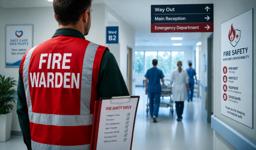
Fire Warden/ Fire Marshal Online Training
Cost: £20.00
Fire Warden / Fire Marshal Training for Care Home StaffProtect residents, support safe evacuations, and meet UK fire safety responsibilities with practical Fire Warden training designed specifically for healthcare and residential care environments.
Online Fire Safety Training for Healthcare Staff
This online Fire Warden course gives care home and healthcare staff the knowledge needed to respond confidently during fire emergencies while supporting vulnerable residents safely.
Built around UK legislation and healthcare best practice, the course focuses on real workplace risks found in residential care settings including evacuation procedures, compartmentation, fire prevention, alarm systems, and Personal Emergency Evacuation Plans (PEEPs).
Suitable for care homes, supported living services, nursing homes, domiciliary care providers, and healthcare organisations across the UK.
Who Should Complete This Course?
This course is ideal for:
Healthcare Assistants
Support Workers
Senior Carers
Nurses
Team Leaders
Domestic Staff
Maintenance Staff
Supervisors acting as Fire Wardens
Course Duration
2 to 3 hours online learning
Self-paced training
Accessible on desktop, tablet, and mobile
Instant certificate on successful completion
Course Aim
The aim of this course is to provide care home staff with the knowledge, confidence, and responsibilities required to act as a Fire Warden or Fire Marshal within healthcare and residential care environments in line with UK fire safety legislation.
What You Will Learn
By the end of the course learners will be able to:
Understand UK fire safety legislation and employer responsibilities
Explain the role of a Fire Warden in a care home setting
Identify common causes of fire in healthcare environments
Recognise fire hazards and carry out prevention checks
Describe evacuation procedures for vulnerable residents
Understand Personal Emergency Evacuation Plans (PEEPs)
Use fire extinguishers safely and appropriately
Respond effectively during fire emergencies
Support safe evacuation and compartmentalisation procedures
Course Modules
Module 1: Introduction to Fire Safety in Healthcare
Learn why fire safety is critical in care environments and understand the legal responsibilities placed on healthcare providers.
Topics include:
Fire risks in residential care settings
Lessons learned from UK care home fires
Regulatory Reform (Fire Safety) Order 2005
Health and Safety at Work Act 1974
CQC expectations and compliance
Module 2: Understanding Fire and How It Spreads
Develop an understanding of how fires start, spread, and create risk within healthcare settings.
Topics include:
The fire triangle
Classes of fire
Smoke and toxic fumes
Conduction, convection, and radiation
Oxygen-enriched environments
Electrical equipment risks
Laundry and kitchen fire hazards
Module 3: The Role of the Fire Warden
Understand the key responsibilities of a Fire Warden before, during, and after an emergency.
Topics include:
Checking escape routes
Identifying and reporting hazards
Supporting evacuations
Liaising with emergency services
Teamwork and communication
Shift handovers and night shift considerations
Module 4: Fire Prevention and Hazard Awareness
Learn how to reduce fire risks within care homes and healthcare workplaces.
Topics include:
Safe storage of oxygen and chemicals
Waste and flammable material management
Electrical safety
Smoking policies
Arson prevention
Housekeeping standards
Fire doors and escape routes
Alarm points and emergency lighting
Module 5: Fire Detection and Warning Systems
Understand how fire alarm systems work and the importance of routine checks.
Topics include:
Fire alarm systems in care homes
Types of detectors
Manual call points
Emergency lighting
Weekly testing requirements
Fault reporting procedures
Module 6: Evacuation Procedures in Care Homes
Learn safe evacuation procedures for vulnerable residents during emergencies.
Topics include:
Progressive horizontal evacuation
Stay put versus full evacuation
Evacuation priorities
Assembly points and roll calls
Ski sheets, evac chairs, and wheelchairs
Supporting residents with dementia, mobility, sensory, and cognitive impairments
Personal Emergency Evacuation Plans (PEEPs)
Module 7: Fire Extinguishers and Safe Use
Understand extinguisher types and when it is safe to tackle small fires.
Topics include:
Water extinguishers
Foam extinguishers
CO2 extinguishers
Dry powder extinguishers
Wet chemical extinguishers
PASS technique
Personal safety considerations
Important reminder:
Fire Wardens are not firefighters. Raising the alarm and supporting evacuation are always the priority.
Module 8: Emergency Response Procedures
Learn how to respond calmly and effectively during fire emergencies.
Topics include:
Actions on discovering a fire
Contacting the Fire and Rescue Service
Communicating with residents and visitors
Managing panic and confusion
Supporting emergency responders
Incident reporting procedures
Module 9: Post-Incident Actions
Understand the importance of post-incident review and continuous improvement.
Topics include:
Re-entry procedures
Welfare support for staff and residents
Incident debriefing
Reporting hazards
Lessons learned and future prevention
Assessment and Certification
Learners will complete a multiple-choice assessment at the end of the course.
Upon successful completion, learners will receive a Fire Warden / Fire Marshal Training certificate suitable for CPD and workplace compliance records.
UK Guidance and References
This course aligns with current UK guidance including:
HM Government Fire Safety Risk Assessment: Residential Care Premises
UK Fire and Rescue Service guidance
CQC Regulation 15: Premises and Equipment
NHS Firecode guidance
Regulatory Reform (Fire Safety) Order 2005
Why Choose This Course?
Designed specifically for healthcare and care home environments
Covers practical evacuation procedures for vulnerable residents
Supports CQC compliance and workplace fire safety requirements
Flexible online learning with instant access
Suitable for all levels of healthcare staff
Enrol Online Today
Give your staff the confidence to respond safely during fire emergencies while helping protect residents, colleagues, and visitors.
Start your Fire Warden / Fire Marshal Training online today.
Please note that refunds are not available for online training purchases.
Nursing and Midwife Council's (CPD Points).
Requirements:
It is necessary to complete 35 hours (35 Nursing CPD Points) of relevant CPD within the three-year period since your last registration renewal or since joining the register.
Of these 35 hours (35 Nursing CPD Points), a minimum of 20 hours (20 Nursing CPD Points), should be dedicated to participatory learning, which involves engaging in activities that facilitate interaction with other professionals.